In the world of industrial automation and process control, data is king. Every second, millions of data points—temperature, pressure, flow rate, and weight—are transmitted from field sensors to control rooms.
But how do you ensure these delicate signals arrive accurately without being corrupted by the harsh, electrically noisy environment of a modern plant?
The answer lies in the unsung hero of industrial connectivity: the Instrumentation Cable.
In this comprehensive guide, we’ll break down the anatomy of instrumentation cables, explore key technical specifications, and give you a checklist to select the perfect cable for your next project.
An instrumentation cable is a specialized, low-voltage shielded cable designed to transmit low-energy electrical signals (typically 4-20mA analog currents, 0-10V voltages, or digital data) from sensors and transmitters to controllers, PLC systems, and data loggers.
Unlike power cables, which are engineered to carry high current and voltage, instrumentation cables are engineered for signal integrity, precision, and maximum protection against electrical interference (noise).
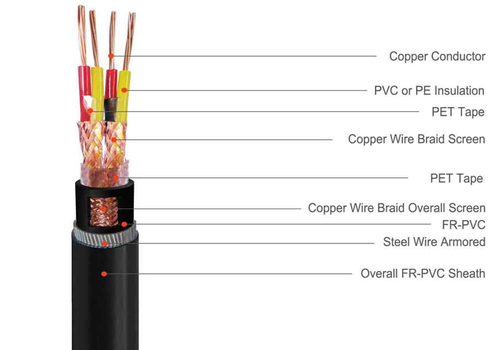
To choose the right cable, you must understand what goes inside it. A standard industrial-grade instrumentation cable consists of several critical layers:
Conductor: Usually made of plain or tinned annealed flexible copper. Pro Tip: Tinned copper offers significantly better corrosion resistance, making it vital for marine, chemical, or humid environments.
Insulation: Surrounds the conductor to prevent leakage. Common materials include:
PVC (Polyvinyl Chloride): Cost-effective and flexible—the standard for general commercial use.
PE (Polyethylene) & XLPE (Cross-linked Polyethylene): Offer superior electrical properties, lower capacitance (crucial for long cable runs), and better temperature resistance.
Pairing / Triading: Conductors are twisted into Pairs (two wires) or Triads (three wires). Twisting cancels out electromagnetic interference (EMI) from neighboring wires.
Shielding/Screening (The Noise Shield): This is the most critical component for signal protection.
Aluminium/Mylar Tape: A metallic foil wrapped around the cores with a tinned copper drain wire to safely ground electrical noise.
Tinned Copper Wire Braid (TCWB): Provides robust mechanical strength and excellent low-frequency shielding.
Inner Sheath / Bedding: A protective layer (often PVC or LSZH) that cushions the inner cores, especially beneath armor.
Armoring (Optional Mechanical Defense): * SWA (Steel Wire Armor) or GSWB (Galvanized Steel Wire Braid) protects the cable from physical crushing, heavy machinery impact, and rodents.
Outer Sheath (Jacket): The first line of defense. Options include standard PVC, hydrocarbon-resistant polymers, or LSZH (Low Smoke Zero Halogen)—which is mandatory for indoor/public space fire safety
When browsing datasheets, you will often see terms like CAM/OS or TIM/ISOS. Choosing the wrong one can lead to severe signal "cross-talk."
Collective Screen (CAM / Overall Screen): The entire bundle of twisted pairs is wrapped in one single shield. This is ideal for preventing external noise from corrupting the signals inside the cable.
Individual & Collective Screen (TIM / ISOS): Each individual twisted pair has its own shield, plus the entire bundle has an overall shield. This is mandatory if you are running different types of signals within the same cable, as it prevents internal pairs from interfering with one another.
One of the most common mistakes in procurement is confusing control cables with instrumentation cables. While they look similar, they serve entirely different purposes:
| Feature | Instrumentation Cables | Control Cables |
| Primary Function | Transmit delicate data/signals from measuring instruments | Carry power to control execution devices (valves, relays, motors) |
| Typical Signals | 4-20 mA analog, 0-10 V, low-voltage digital | 110/230 VAC, 24 VDC power control circuits |
| Core Configuration | Twisted Pairs or Triads (e.g., 1P, 2P, 4P) | Numbered multi-cores (e.g., 4G1.5, 7C) |
| Noise Protection | High (Mandatory shielding/screening) | Moderate (Often unshielded, or simple braid) |
To ensure safety and reliability, always check that your cables meet international manufacturing and testing standards:
EN 50288-7 (European Standard): The standard benchmark for instrumentation cables rated up to 300 V.
IEC 60332: Defines the standard for flame retardancy of electrical cables.
UL 13 / UL 2250 (US Standards): Covers Power-Limited Circuit Cables (PLTC) and Instrumentation Tray Cables (ITC) used across North America.
Before placing your next order, ask your engineering or procurement team these four questions:
Where will it be installed? For public buildings, metros, or data centers, specify LSZH. For outdoor trays, ensure UV and Ozone resistance.
Is there a risk of mechanical damage? If the cable is buried directly in dirt or laid where heavy equipment operates, choose SWA (Steel Wire Armored).
Are hazardous chemicals present? In petrochemical plants, specialized hydrocarbon-resistant jackets (like Nylon/PVC) or lead sheaths are required to prevent chemical penetration.
Are the signals digital or analog? High-speed digital protocols (like Modbus, Profibus, or Fieldbus) have strict impedance requirements (100-120 Ω) and may require dedicated bus cables rather than standard instrumentation types.
Contact: Lisa
Phone: +86-13775603923
E-mail: lisa@shengcable.com
Whatsapp:+8613775603923
Add: No.7577 of Hunan Rd., Pudong New Area Shanghai 201314, China