Conductors: Usually stranded copper for flexibility and better conductivity.
Insulation: PVC (standard), PE (low capacitance), or XLPE (high temperature).
Screening/Shielding: The "armor" against Electromagnetic Interference (EMI).
Sheath/Jacket: Protects against oils, chemicals, and mechanical stress (PUR or LSZH).
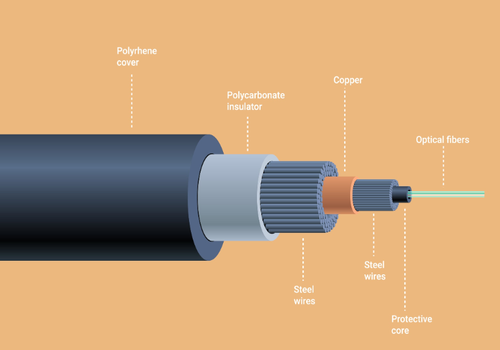
Based on construction and application, these are the primary categories found in modern plants:
Type | Best Used For | Key Feature |
| Multi-Core (Unshielded) | Simple status signals (On/Off) in low-noise environments | Cost-effective and flexible |
| Shielded (Foil/Braid) | Analog sensors (Pressure, Temp) near power lines | Uses a "Drain Wire" to ground EMI |
| Twisted Pair (TP) | Long-distance data transmission | Twisting cancels out magnetic interference |
| Instrumentation Cable | Critical control loops in oil, gas, and petrochemicals | Often includes individual and overall shielding |
| Fieldbus/Ethernet | High-speed digital communication (ProfiBus, Modbus, Cat6) | Controlled impedance for high-speed data |
Foil Shield (Al-Mylar): 100% coverage; excellent for high-frequency RFI but fragile in flexing applications.
Braid Shield (Copper): 60-95% coverage; superior mechanical strength and better for low-frequency EMI.
Combination: For the "noisy" environments, use both.
Static: Fixed installation in trays or conduits.
Flexible (C-Track): Specifically designed for robotic arms or moving machinery where the cable will bend millions of times.
PVC: General purpose.
PUR (Polyurethane): Highly resistant to abrasion, oils, and coolants—the gold standard for CNC machines.
LSZH (Low Smoke Zero Halogen): Mandatory in tunnels or poorly ventilated areas to prevent toxic gas during fires.
When sourcing, ensure the cables meet these global benchmarks:
UL/CSA: Required for the North American market.
CE/EN: Required for European safety standards.
RoHS/REACH: Ensures the cable is free from hazardous substances like lead.
VDE: German standard often used as the benchmark for high-quality industrial automation.
A shielded signal cable is only as good as its grounding. In most industrial applications, the shield should be grounded at one end only (usually the controller side) to prevent "ground loops," which can actually introduce more noise than they remove.
Summary: For high-precision analog signals, always opt for Shielded Twisted Pairs (STP) with a PUR jacket if the environment involves oils or constant motion. For simple logic signals, a standard Multi-core PVC cable usually suffices.
Contact: Lisa
Phone: +86-13775603923
E-mail: lisa@shengcable.com
Whatsapp:+8613775603923
Add: No.7577 of Hunan Rd., Pudong New Area Shanghai 201314, China