In the volatile world of oil and gas, a cable is never "just a wire." It is a lifeline.
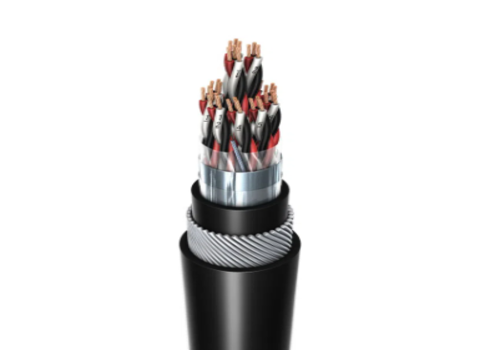
Cables are classified by their "battlefield." Where they are installed dictates their DNA.
Topside cables must survive a brutal trifecta: salt spray, intense UV radiation, and drilling fluids.
1) The Gold Standards: NEK 606, IEC 60092, and IEEE 1580 (Type P).
2) RFOU: Flame retardant and mud resistant. Features Tinned Copper Wire Braid (TCWB) for mechanical shielding.
3) BFOU: Fire resistant. These include a Mica glass tape layer that allows the cable to maintain circuit integrity even while the outer layers are burning.
Deployed on the seafloor, these transmit power and hydraulic control to subsea trees.
The Critical Feature: Water-blocking. Under high hydrostatic pressure, water can "wick" through a cable. The best subsea cables use lead sheathing or specialized swellable tapes to prevent longitudinal ingress.
Used inside the wellbore for Electrical Submersible Pumps (ESP).
1) The Stressors: Temperatures exceeding 230°C (450°F) and "sour" gas (H2S).
2) The Build: They are typically armored with galvanized or stainless steel tapes to resist crushing and rapid gas decompression (RGD).
"Best" cable is defined by its layers. Here is how modern materials compare:
| Feature | Material / Standard | Why it's the "Best" Choice |
| Conductor | Tinned Copper | Prevents oxidation in salt air; ensures reliable terminations in humid zones |
| Fire Safety | LSZH (Low Smoke Zero Halogen) | Prevents the release of toxic gases and thick smoke, ensuring clear evacuation paths |
| Mud Resistance | NEK 606 | Essential for drilling decks; resists degradation from aggressive synthetic drilling fluids |
| Circuit Integrity | IEC 60331 | Guarantees that emergency shut-off valves and lighting work for 90–180 minutes during a fire |
Before you sign off on your next procurement, ensure these three modern benchmarks are met:
Modern drilling uses synthetic-based muds that act as aggressive solvents. If a cable isn't explicitly rated as Mud Resistant, the jacket will swell and crack within months.
Pro Tip: Always verify that cables are tested against IRM 902 or IRM 903 oils.
Don't confuse the two.
-Flame Retardant (IEC 60332): The cable won't spread the fire, but it stops working once it burns.
-Fire Resistant (IEC 60331): The cable keeps working. This is mandatory for fire pumps and emergency communication systems.
High-end cables often include Fiber Optic Distributed Temperature Sensing (DTS). This allows operators to monitor for hotspots or structural fatigue in real-time, preventing blowouts before they happen.
-For Offshore Platforms: Stick to NEK 606 RFOU/BFOU. They remain the industry benchmark for combining mud resistance with fire safety.
-For Land-Based Refineries: Look for high-performance VFD (Variable Frequency Drive) cables with XLPE insulation. They offer superior control for large motors while resisting chemical spills.
-For Extreme Depth: Lead-sheathed cables are still the undisputed champions against high-pressure hydrogen and chemical permeation.
Contact: Lisa
Phone: +86-13775603923
E-mail: lisa@shengcable.com
Whatsapp:+8613775603923
Add: No.7577 of Hunan Rd., Pudong New Area Shanghai 201314, China